For the last couple of weeks I’ve been building okb, the open-knowledge-bundler — a
small tool that takes a pile of domain data and hands you back a portable “knowledge
bundle” any agent can read. Under the hood it builds a DuckDB
knowledge graph, exports it as a cat-readable open knowledge format
bundle packaged as a Claude-compatible “skill,” and ships a chat agent that answers
questions about it. The whole thing runs fully local, on a single AMD chip on my
desk. No API keys, no cloud, no embedding server.
I started with a pretty narrow question: how small can a local model be and still answer graph questions usefully? I expected to find a floor, some parameter count below which the thing just falls apart, write it up, and move on. That’s not where I landed. What I got instead was a self-contained way to bundle domain knowledge into portable skills, plus a result I keep turning over in my head: a 4-bit 12B model on my desk answered questions about a medical corpus as well as frontier Claude reading the exact same data.
This is the story of how I got to those numbers, and why I think they point at a genuinely different way to package domain knowledge for AI. Not by fine-tuning a model, but by building a small, inspectable, model-agnostic graph that any agent can pick up and answer from.
The system, in one breath
okb keeps a deliberately boring data model: typed nodes (entities with properties
and an embedding) and typed, directed edges, all in one DuckDB file. Four DuckDB
extensions turn that file into a hybrid search engine: vss for vector similarity, fts
for BM25 lexical search, spatial for geometry, and duckpgq for property-graph
traversal (MATCH, GRAPH_TABLE). Search fuses the lexical and semantic channels with
Reciprocal Rank Fusion, with graph queries on top.
The thing it actually produces — the payoff — is what I’ve been calling an OKF
bundle: a directory holding a SKILL.md that explains the domain, one markdown
concept doc per entity (relationships rendered as cross-links you can follow by eye),
and the database itself. It’s human-readable, agent-readable, and precisely queryable
all at once. Hand that one directory to anything that can read files and run SQL, and
it knows your domain. That bundle is the product.

Building the Pokémon bundle, then cat-ing one concept doc. The graph is just
cross-linked markdown plus a database you can query — nothing to stand up to read it.
The local agent (okb agent --bundle ./some-bundle) answers over it using Gemma 4
for generation and EmbeddingGemma-300M for retrieval, both running under Vulkan on
an AMD Ryzen AI MAX+ 395 (“Strix Halo”). It answers only by calling tools — schema,
read-only sql_query, hybrid_search, and doc browsing — never from memory. That last
constraint turned out to matter more than anything else, and it’s the first thing the
benchmarks taught me.
Grounding isn’t a model trait. You build it in.
The first time I graded the agent — against a hand-built Pokémon graph, six questions, answers pulled straight from the DB — it got 3 of 6. But the worst miss wasn’t a wrong answer. It was a convincing one. I asked for Eevee’s evolutions, where my graph holds exactly three, and it cheerfully returned all eight real-world Eeveelutions. What happened: its SQL errored out, and instead of saying so, it quietly fell back to training data. The first three were right, which is exactly what made it dangerous.
The fix wasn’t a smarter model. It was a hard rule in the system prompt — every fact must come from a tool result in this conversation; if the tools don’t return it, say you couldn’t find it — plus making the schema honest, because the model had been guessing field names and inverting relationships. Surface the per-type property keys and the edge directions, and the guessing stops. That took it to 5 of 6, with the sixth now failing honestly: “I couldn’t find it in the graph.”
I’d argue that’s a better outcome than it looks. For a retrieval agent, an honest “I don’t know” beats a confident fabrication every time, because you can build on the former and you can’t build on the latter. That one design choice — engineering the honesty in, rather than hoping the model has it — is what makes everything downstream trustworthy. And it’s what lets a small model be useful at all: when it can’t do something, it declines instead of inventing.
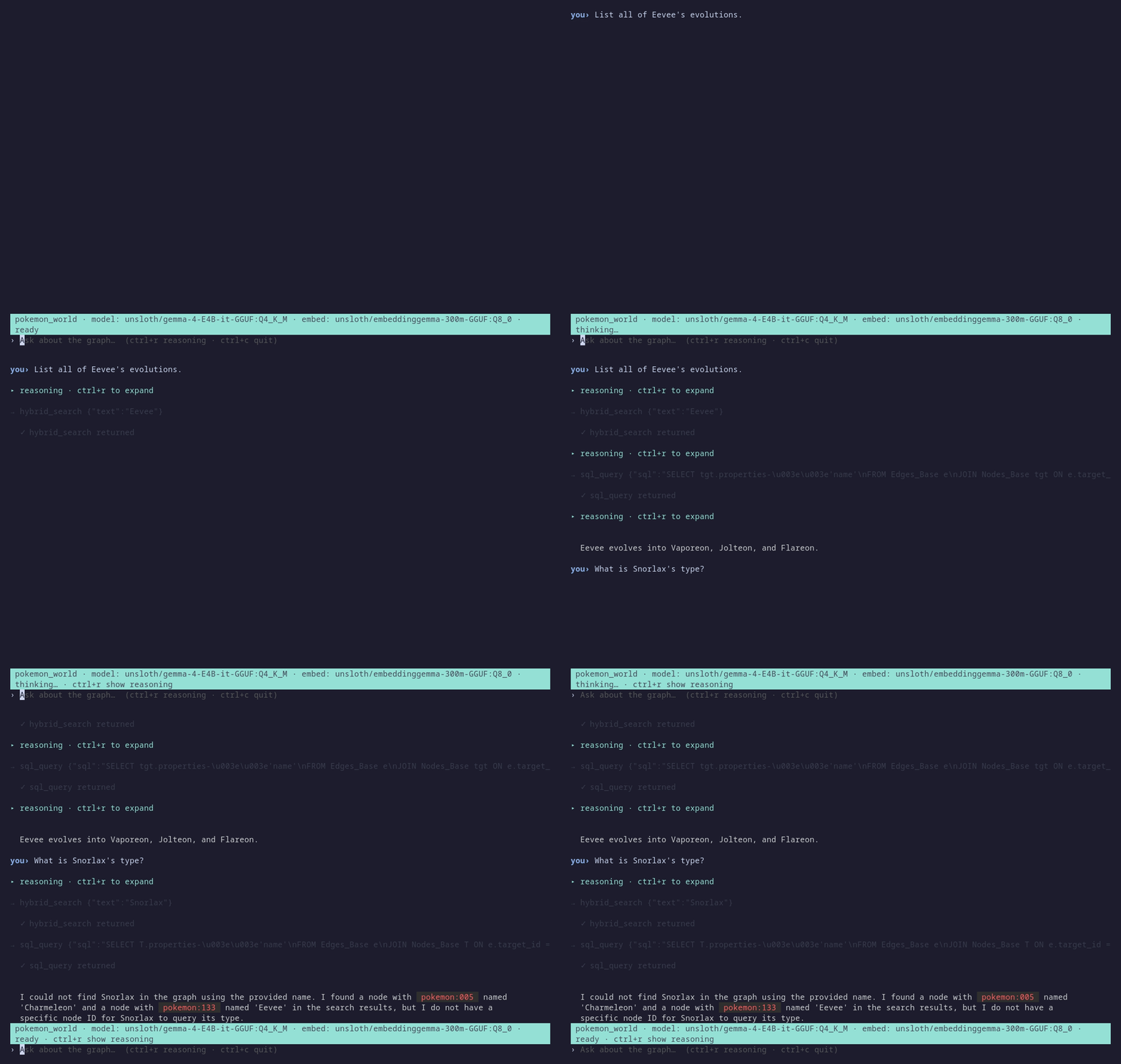
The grounded agent, fully local: Eevee’s three evolutions pulled straight from the graph, and an honest “couldn’t find it” when I ask about a Pokémon that isn’t in there.
How small can you go?
Back to the original question. I auto-generated 83 Pokémon questions (templated over every relation, gold answers straight from SQL) and ran the two smallest Gemma tiers head to head, scored deterministically on recall, exact-match, and precision, which catches over-generation without an LLM judge anywhere in the loop.
Overall exact-match accuracy (n=83)

  E2B  (~2.3B, Q4_K_M)   ████████████░░░░░░░░░░░░░░░░░░░░░ 34.9%  (29/83)
  E4B  (~4.5B, Q4_K_M)   ████████████████████████████░░░░░ 83.1%  (69/83)
Double the parameters, ~2.4× the accuracy. But the shape of the gap was the interesting part, not the headline number. The small model collapses on reverse traversal — “which Pokémon are Fire type,” where you filter the target, gather the sources, and invert the edge — scoring 7%, while E4B is direction-agnostic at 80%.
And here’s the result I keep coming back to: honest failure scales down with the model. E2B fails far more often, sure, but ~72% of its failures are honest “not found,” which is virtually the same honest share as E4B’s. The small model is dramatically less capable and barely more deceptive. The grounding holds even when the model is weak.
So model size buys you capability: harder query shapes, multi-answer completeness. It doesn’t buy you integrity. That you get from design, and the distinction is about to do some real work.
A real corpus, graded on my own machine
Pokémon is a toy. To test against something I didn’t build myself, I pointed the system
at GraphRAG-Bench’s medical
track: a ~1 MB prose corpus with graded questions in four styles (Fact Retrieval,
Complex Reasoning, Contextual Summarize, Creative Generation), normally scored by a
gpt-4o-mini judge.
okb ingests structured graphs, so I needed an extraction pass to turn prose into a
graph first. As a quick first cut I had a local Qwen-35B read the corpus in chunks and
emit entities and relations — a throwaway script, one pass, no cleanup. Then I ran the
entire evaluation loop locally: answering with Gemma, and judging with that same local
Qwen (GraphRAG-Bench’s eval speaks OpenAI, so I just pointed base_url at localhost).
Nothing left the box.
Two things came out of that run. The first was a dull but critical bug. The agent was loading at llama.cpp’s default 8k context, and long tool loops overflowed it into blank answers. The fix had two parts: bump the context to 32k, and cap each tool’s output so a single fat result can’t flood the window on its own. On the medical sample that turned 5 previously-blank answers (the kind that needed nine tool calls each) into real ones.
The second was more interesting: coverage and capability are coupled. Scaling the graph made the small E4B model slightly worse, since it drowned in the extra density, while the same dense graph in front of Gemma 12B turned that density into signal and climbed to 0.520 overall answer-correctness, led by Complex Reasoning at 0.590.
For context, the published GraphRAG-Bench medical systems (GPT-4o-mini as both generator and judge) sit in roughly the 0.54–0.68 band. A 4-bit local 12B, reading a naïve one-pass graph, judged by a different model, landing at 0.52 was a lot closer than I expected. And it set up the question I actually cared about.
Same graph, frontier brain
The OKF bundle is a portable skill. So the obvious thing to try: what happens if I hand it not to local Gemma, but to a frontier model?
I spun up Claude Sonnet subagents, gave each one the same medical bundle, and let them
answer the same 32-question sample using the bundle’s generic toolkit — the duckdb
CLI, okb query, the markdown docs — under the same “ground every fact, no outside
knowledge” rule. Then I scored them with the same local judge that graded the local
agent. Apples to apples on everything except the brain doing the reading.
Answer-correctness, same graph, same judge (n=32)

  question type          local 12B    Sonnet      Δ
  Fact Retrieval            0.404       0.429    +0.025  Sonnet
  Complex Reasoning         0.590       0.453    −0.137  12B
  Contextual Summarize      0.565       0.517    −0.048  12B
  Creative Generation       0.520       0.563    +0.043  Sonnet
  ──────────────────────────────────────────────────────────
  OVERALL                   0.520       0.491    −0.029  ~tie
The frontier model did not win. A model orders of magnitude larger, reading the exact same graph, came in at 0.491, a statistical tie with and nominally below a 4-bit 12B running on my desk. I want to be fair here: Sonnet is a far better reasoner and writer, and you can see exactly where that earns its keep, since it edges ahead on Fact Retrieval and Creative Generation. But it can’t retrieve facts that aren’t in the graph. I asked for adrenocortical-carcinoma symptoms, where the gold answer lists fifteen and my graph held two; Sonnet navigated harder than Gemma did and hit the same wall. Pheochromocytoma had no node at all, and no amount of intelligence reads a node that doesn’t exist.
That’s the whole thesis in one table: the expertise is in the graph, not in the model reading it. Which means the bottleneck, and all the leverage, is extraction. So I went and built a real one.
Build a better graph, and the small model pulls ahead
The throwaway Qwen script had left obvious damage behind: duplicate entities
(hodgkin_lymphoma, _2, _3), a sprawling ~150-relation vocabulary with
inconsistent directions, missing nodes, and facts attached at the wrong granularity. So
I built a proper extraction pipeline inside okb — fully local, in-process, a 12B
model running five stages with no external server anywhere:
- Bootstrap an ontology — propose a compact, closed set of entity types and directional relations from a sample of the corpus, then let me edit it.
- Extract — per chunk, emit entities and relations as structured JSON, with the
type/relationfields enum-constrained to the ontology at the token level (a GBNF grammar via kronk’sresponse_format), so the vocabulary can’t sprawl and the JSON is always valid. - Glean — a recall pass that re-reads each chunk for whatever the first pass missed.
- Resolve — embed every entity and merge duplicates into canonical nodes.
- Normalize — collapse the relation vocabulary down to one canonical direction.
Then I re-ran the exact same 32-question benchmark. The first full run regressed hard: 0.405, well below the old Qwen graph’s 0.520. Honestly, that failure turned out to be the most useful thing in the whole project.
The culprit was entity resolution doing its job too well. My first clustering pass used
single-linkage: if A is similar to B and B to C, all three merge. On a medical corpus
that chains catastrophically (cancer ~ breast cancer ~ adenocarcinoma ~ …), and
120+ distinct cancers collapsed into a single disease:cancer node carrying 349 aliases.
Fact Retrieval cratered from 0.404 to 0.285. Over-merging destroys a graph just as
thoroughly as under-merging does, and you can’t see it in the node count, which is what
makes it nasty.
The fix was representative-based (leader) clustering: a candidate joins a cluster only if it’s similar to that cluster’s representative, not merely to some member, which kills the transitive chaining. An LLM adjudicator settles the genuinely ambiguous pairs in between. I also pushed the thresholds up (auto-merge 0.86 → 0.93, with a 0.86–0.93 gray band routed to the adjudicator instead of merged blindly). The 349-alias hub broke back apart into 81 distinct cancer subtypes.
The part that made this bearable: I’d started persisting the pre-resolution graph to
raw-extraction.json, so okb extract --from-raw re-runs resolve → normalize → emit
without re-extracting. Re-tuning resolution went from an overnight job to a
minutes-long loop. And the score didn’t just recover, it took the lead:
GraphRAG-Bench medical, same 32 questions, same local judge

  graph + answerer                       overall   Fact Retrieval
  v1: Qwen-35B one-pass + local 12B     ░░░ 0.520   0.404
  Sonnet over the v1 bundle             ░░░ 0.491   0.429
  okb extract (over-merged) + 12B       ░░  0.405   0.285   ← the regression
  okb extract (leader-clustering) + 12B ███ 0.581   0.452   ← fixed
0.581 overall, beating both the 35B-built graph (0.520) and frontier Sonnet (0.491). Fact Retrieval, the most extraction-bound metric, recovered to 0.452 and landed ahead of Sonnet’s 0.429. Same small local answerer the whole way through. The only thing that changed was the quality of the graph it was reading.
That’s the thesis, confirmed and then flipped: a better graph didn’t just close the gap to the frontier model, it lifted a 4-bit local model clean past it. Entity resolution turned out to be the single highest-leverage knob in the whole system, and it’s a data-engineering problem, not a model problem.
What this is actually good for
Put the three pieces together — grounding is design, capability is measurable, the graph is the expert — and a build pattern just falls out of them. I’ve been calling it a micro-scale domain expert: a single OKF bundle for one bounded domain. Your product’s data. An internal runbook corpus. A regulatory standard. A research literature. A customer’s catalog. Whatever. And it has four properties I care about:
- It’s self-contained. One directory — markdown you can read, a database you can
query, a
SKILL.mdthat explains both. Nothing to deploy just to use it. - It’s portable across brains. The same bundle works under a 4-bit local model (for privacy, cost, or air-gapped use) and a frontier model (for the hardest reasoning or the nicest prose), because the interface is “read files, run SQL,” which everything speaks. You pick the model per job. You’re not locked in.
- It’s inspectable. When it’s wrong, you
catthe concept doc or run the SQL and see why. The failure is a missing edge, not an inscrutable weight. - It’s cheap to make, and the cost lands in the right place. The benchmarks say the model is more or less interchangeable, so you don’t spend there. You spend on extraction quality — the right entities, resolved and de-duplicated, with a clean relation vocabulary. That’s the lever, and it’s measurable: the same harness that surfaced the over-merge regression in minutes is the one that proved the fix.
This is a different shape from “fine-tune a model on your domain” (expensive, opaque, frozen, prone to hallucinating right past the gaps) and from “stuff everything into a context window” (no structure, no traversal, re-paid on every single query). A micro-expert is a durable, queryable, versioned artifact. You build a fleet of them, one per domain, and route whatever agent you like at whichever one it needs.
Last bit
The project that started as “can a tiny model answer graph questions on my laptop” turned into something I find a lot more interesting: a way to manufacture portable, honest, model-agnostic domain experts, where the intelligence you’re buying lives in the data you curate rather than the model you run.
And a 4-bit model on my desk beating frontier Claude on the same benchmark isn’t a knock on Claude. I want to be clear about that. It’s the best news in the whole project. It means the expensive, scarce thing isn’t the bottleneck. The graph is. And graphs, you can build.
Stack: okb (Go) · DuckDB 1.5 (vss/fts/spatial/duckpgq) · kronk + llama.cpp
(Vulkan) for local inference and embeddings, with the agent loop on
fantasy · answerers: Gemma 4 E2B/E4B/12B
Q4_K_M (local) and Claude Sonnet (over the OKF bundle) · in-process extraction + local
judge: Qwen3.6-35B / Gemma 4 12B · EmbeddingGemma-300M / BGE-small embeddings ·
GraphRAG-Bench medical corpus, 32-question stratified sample, same local judge across
every answerer · AMD Ryzen AI MAX+ 395 / Radeon 8060S.